Researcher of the month of September - Dr. Fides Emmanuel
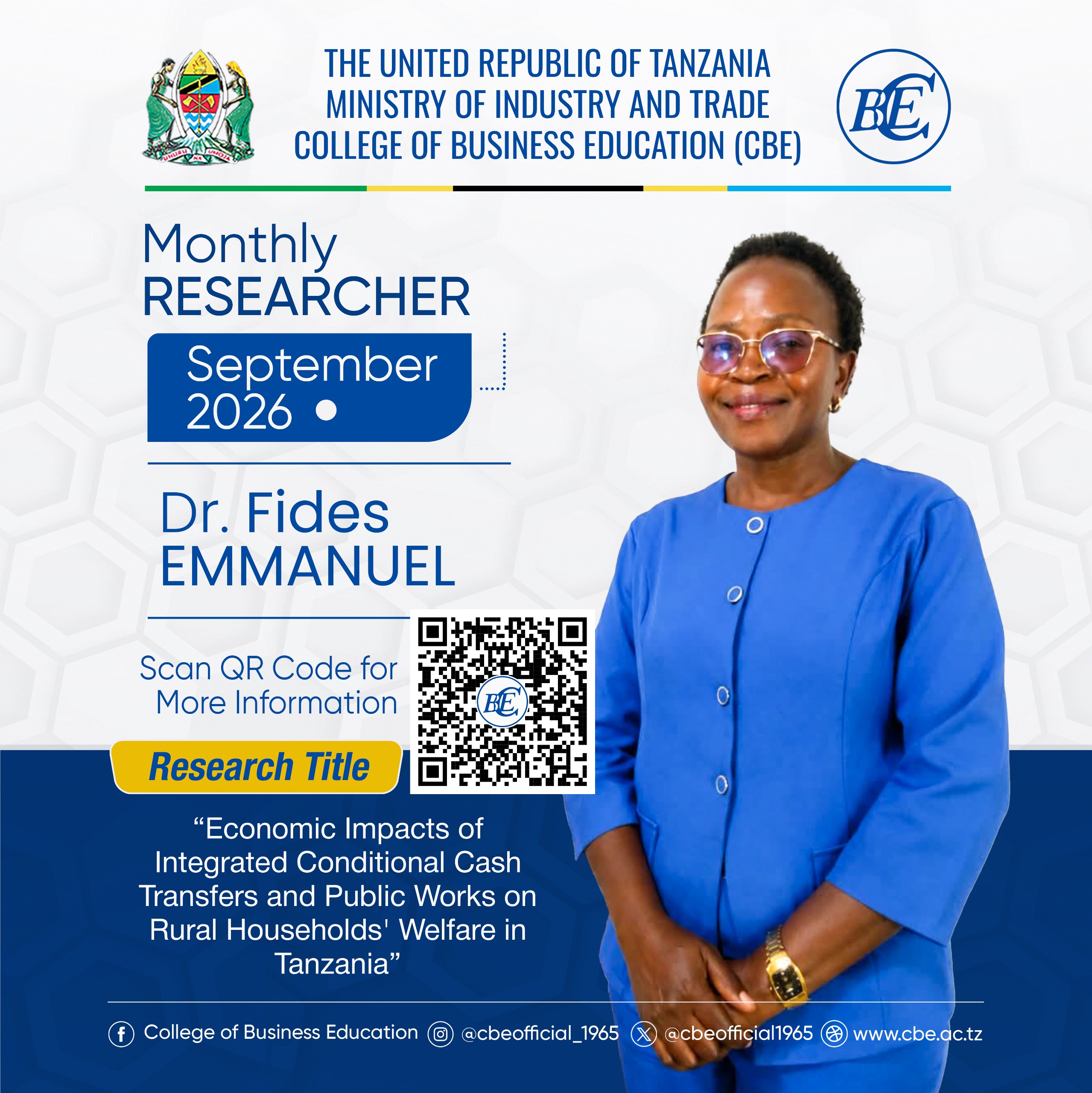
RESEARCHER OF MONTH SEPTEMBER 2026
Do Cash Payments and Public-Works Jobs Together Help Poor Rural Families in Tanzania?

What is this research about, and why does it matter?
This study looked at a government programme in Tanzania called the Productive Social Safety Net (PSSN). It is titled Economic Impacts of Integrated Conditional Cash Transfers and Public Works on Rural Households' Welfare in Tanzania. The programme does two things at once for poor rural families: it gives them small, regular cash payments (as long as they meet certain conditions), and it pays them to do public-works jobs, such as building roads or clearing land. The question was simple: does combining cash payments with public-works jobs actually make families better off — and if so, how?
The study measured this in three ways: whether families earned more, whether they built up more belongings and useful things like livestock and land, and whether they could get through a crisis (such as a bad harvest or a sick family member) without doing something harmful, like selling everything they own.
This matters because cash and public-works programmes are used all over the world to fight poverty, but no one had clearly shown whether doing both together works better than doing just one. Many Tanzanians are poor, and rural families are hit hardest. The country’s own development plans, and the global goal of ending poverty by 2030, depend on programmes like this one working well. Most earlier studies only checked whether families spent more on food and daily needs. This is one of the first studies in Tanzania to look at income, belongings and crisis-coping all together.
What did the research find?
The study compared 357 rural households — 175 who were in the programme and 182 similar households who were not — in three districts: Misungwi, Itilima and Ngara. Three main things stood out.
Families in the programme owned more
- They had more livestock and household items than families outside the programme.
- About half (52%) lived in better houses with iron roofs. They owned roughly 13% more land and harvested about 10% more crops.
- Families did best when they spent money on livestock, seeds and tools, ran a small business, and — above all — joined a savings group.
- Even so, only about 1 in 10 families reached the “well-off” group. Nearly half stayed in the poorest group even after five years in the programme.
Families coped better with hard times
- Housing problems dropped (about 11% fewer). Far fewer families had to beg or ask others for help (down about 36 in every 100), and fewer had to sell valuable belongings or send their children away to relatives.
- When trouble hit, programme families were much more likely to use their savings than to sell what they owned.
Families changed how they earned, more than how much
- More families worked for themselves. They did a little less day-labour for others and put more time into their own farms and small businesses.
- A closer look at 22 of the most successful families showed that those who put their money into livestock and farming earned about TZS 74,000 a month — well above the group average of TZS 43,100. This shows what the programme can do when the money is spent on things that earn more money.
In short: the programme clearly helps families build up belongings and handle emergencies. But on its own, it does not put enough extra money in their pockets to lift most of them out of poverty. What makes the biggest difference is how families use the money — those who invest in livestock, farming and savings groups improve the most.
How can these results be used in practice?
The findings point to clear, practical steps for governments, donors and the people who run these programmes.
When designing the programme
- Gently encourage families to spend some of the money on things that pay off later — livestock, seeds, tools and fertiliser — rather than leaving every spending choice open.
- Offer the public-works jobs more often and more reliably. Families were promised about four rounds of work a year but usually got only two, which left them with less lump-sum cash to invest.
- Add basic animal-health support (vaccinations and advice) so families don’t lose animals as their herds grow.
When choosing who joins and tracking progress
- Watch whether families are building up belongings — it was the clearest sign of progress and the easiest to measure.
- Push savings groups. Joining one was the single best sign that a family would move up, and it costs very little to encourage.
When making policy and funding decisions
- Don’t assume that bigger payments alone will end poverty. What lifts families up is how they invest the money, not the size of the payment.
- Use this study’s three-part check — income, belongings and coping — as a model for judging future programmes. It gives a fuller picture than only looking at spending.
How was the research done?
This was a comparison study. The researcher compared families in the programme with similar families who were not in it, in three regions around Lake Victoria where the programme runs. Several tools were used to keep the comparison fair and the findings reliable:
- A matching method that paired each programme family with a very similar non-programme family, so any difference could be credited to the programme rather than to some families simply being better off to begin with.
- A method that combined many belongings (livestock, land, household goods and more) into a single “wealth score” for each family.
- A method that showed which spending choices and activities were linked to a family moving up.
- Simple averages and comparisons to check the differences between the two groups in income, belongings and coping.
The study also drew on well-known ideas about how families manage money over time — saving in good years to get through bad ones — and how they protect themselves against risk. These ideas help explain why families behaved the way they did.
Overall, the study gives solid evidence for designing, targeting and judging cash and public-works programmes — especially where the goals are helping families invest, build up belongings and withstand hard times.
For more information, please contact
Fides Emmanuel